Showing posts with label Daily Health Videos. Show all posts

Thursday, 15 October 2020

Elevated White Blood Cell Count (WBC) Linked With Cardiovascular Disease

A growing body of evidence suggests that low grade inflammation contributes to the development of cardiovascular disease and, specifically, coronary artery disease (CAD). WBC-derived macrophages and other phagocytes are believed to contribute to vascular injury and atherosclerotic progression. Multiple markers of inflammation have been tested as potential risk factors for the development of CAD such as IL-6, E-selectin and CRP.

Elevated white blood cell count (WBC) that is well within the normal range was associated with an increased risk for developing CAD in multiple studies. 

A large-scale study demonstrated that a single measurement of WBC in healthy young men may predict CAD incidence independently from other risk factors for CAD such as elevated lipids, and a positive family history. WBC level above 6,900 cells/mm3 was associated with a 2-fold increase in the risk for CAD with a significant 17.4% increase in CAD incidence observed for every increment of 1,000 WBC/mm3: https://journals.plos.org/plosone/article?id=10.1371/journal.pone.0047183

An elevated WBC count may enhance atherogenesis. Granulocytes and monocytes are believed to be involved in the pathogenesis of atherosclerosis. Monocyte-derived macrophages produce oxidants that can induce endothelial cell injury and subsequent thrombus formation. Activated WBCs also reflect the inflammatory activity of atherosclerosis that perpetuates vascular injury and tissue ischemia.

WBC count is associated with several cardiovascular disease risk factors:

- positive associations with body weight, systolic blood pressure, cigarette smoking, fasting glucose level, and fasting insulin level

- negative associations with high density lipoprotein cholesterol level, family income, alcohol consumption, and physical activity or physical fitness

High-normal WBC count is an independent and reliable risk factor for CAD.

The joint effect of WBC count, a readily available measurement, with other known risk factors for CAD may help to better identify people at either high or low cardiovascular risk.

References:

https://journals.plos.org/plosone/article?id=10.1371/journal.pone.0047183

https://www.ncbi.nlm.nih.gov/pmc/articles/PMC5533311/

https://academic.oup.com/aje/article/154/8/758/131409

via CasesBlog - Medical and Health Blog More READ

Thursday, 1 October 2020

Latest in lipidology: is lipoprotein(a) "the most dangerous particle you’ve never heard of"?

Dr Attia's podcast on Lp(a), the link is here: https://peterattiamd.com/tomdayspring6/

Discussed:

- ApoB as a preferred metric over LDL-P [16:30]; Atherogenic lipoproteins (apoB/LDL-P) as front and center in pathogenesis of CVD. ApoB and LDL-P are used interchangeably, but this is not quite accurate.

- Therapeutic goals for apoB concentration [21:45]

- Lipoprotein(a)—the most dangerous particle you’ve never heard of [55:00];
preferred lab measurements [1:17:45]; 

Lipoprotein(a), or Lp(a), is a distinctive particle with 2 components: 

 - a lipoprotein core that resembles LDL
-  a shell that contains apolipoprotein(a), or apo(a)

Lp(a) is dubbed one of the final frontiers in lipid management. Elevated blood Lp(a) levels are primarily due to genetic variations in the LPA gene that encodes for apo(a) and cannot be lowered by diet, exercise or current lipid-lowering therapies. 

“By combining the atherosclerotic effects of LDL with the prothrombotic effects of apo(a), elevated Lp(a) essentially delivers a double whammy of noxious atherothrombotic effects", as per Dr Nissen. 

Normal Lp(a) levels are less than 25 mg/dL, with significant risk of atherothrombotic events beginning at levels 50-70 mg/dL and rising thereafter. And that risk is not at all rare: 64 million U.S. residents have an Lp(a) level of 60 mg/dL or higher. Over 3 million have levels of 180 mg/dL or more, which confer extremely high risks. There are no effective Lp(a)-lowering pharmacotherapies to date. That includes statins, which actually can slightly raise Lp(a) levels.

It is estimated that about one in five people in the U.S. has an Lp(a) level that puts them at risk. And, even people with a healthy level of LDL cholesterol could have a high Lp(a) level. So many people are walking around with abnormally high Lp(a) but don’t know it. Lp(a) could be a factor in the rise in heart attacks in younger, seemingly healthy adults who do not have high LDL cholesterol. The other tricky thing is that your Lp(a) level is in large part genetically wired, so things like diet and exercise won’t really change it. There are currently no FDA-approved drugs to lower it, either. Focus on strategies for lowering that risk focus on addressing other risk factors, such as high LDL cholesterol, BMI and blood pressure.

Here is Dr Nissen and Dr Cho from Cleveland Clinic on Lp(a). They discussed rosuvastatin 5 mg once a week. Dr Nissen mentioned that rosuvastatin at 1 mg per day reduced LDL by 33%. Rosuvastatin has a very long half life of 19 hours vs 14 hours for atorvastatin. Rosuvastatin is hydrophilic vs atorvastatin which is lipophilic.


References:

https://health.clevelandclinic.org/why-would-my-doctor-order-a-lipoproteina-blood-test/

https://consultqd.clevelandclinic.org/elevated-lipoproteina-is-a-long-sought-treatment-finally-on-the-way/

Mayo Clinic Lp(a) review and some nice diagrams and algorithm flow charts: https://www.mayoclinicproceedings.org/article/S0025-6196(13)00795-7/pdf

via CasesBlog - Medical and Health Blog More READ

Monday, 28 September 2020

"At the end of our lives, we all become philosophers"

"At the end of our lives, we all become philosophers" is a quote from the podcast episode "Life Lessons From Dead Philosophers" by AoM:

https://www.artofmanliness.com/articles/podcast-643-life-lessons-from-dead-philosophers/

The Greek word “philosophy” (philosophia) is a compound word, composed of two parts: 'Philos' (love) and 'Sophia' (wisdom), "love of wisdom". 

Eric Weiner traveled thousands of miles around the world to visit the haunts of philosophers as he sought to better understand their insights and how he might apply them to his own life. He wrote about this philosophic pilgrimage in The Socrates Express: In Search of Life Lessons From Dead Philosophers

Google Podcasts link

via CasesBlog - Medical and Health Blog More READ

Thursday, 24 September 2020

"Bacon is a Killer": 1 daily serving of processed meat, such as bacon, increases risk of colorectal cancer by 18% - Physicians Committee PSA

According to the World Health Organization, eating even one serving of processed meat, including bacon, daily increases the risk of colorectal cancer by 18 percent. This public health awareness campaign
is sponsored by The Physicians Committee—a nonprofit of 12,000 doctors.

https://www.youtube.com/watch?v=eZ1Va4NaU5E

via CasesBlog - Medical and Health Blog More READ

Wednesday, 8 July 2020

The most practical/cost effective point of care ultrasound (POCUS) device as of 2020: Butterfly iQ

From CNN:

"Handheld devices also cost much less than traditional ultrasound machines. The ones sold by Butterfly, GE and Philips range in price from around $2,000 to $5,000, whereas traditional devices can cost tens or even hundreds of thousands of dollars.

The Butterfly iQ is currently equipped for 19 different types of scans and tests. A "major" limitation is the inability to perform the spectral Doppler test used to identify some more acute heart conditions."


The Butterfly iQ costs $2,000. There is a first-year fee of $400:

https://store.butterflynetwork.com/us/en/iq/configure/

References:

https://www.cnn.com/2020/07/08/tech/ultrasound-machine-handheld-coronavirus/index.html via CasesBlog - Medical and Health Blog More READ

Thursday, 21 May 2020

Best longevity app as of 2020? LifeExtend, and it's free

Among the longevity apps, LifeExtend is the clear winner as of May 2020. The app is evidence-based, has great references and it is free: https://lifeapps.io/apps/life-extend/

It is backed by the physician/entrepreneur Don Brown (LifeOmics) and the University of Indiana, so it is not going away next year.

The app is packed with features and you can dig deeper in any of the domains/5 pillars when you have time.

LifeExtend is based on 5 scientifically proven health pillars, they appear as 5 columns and you collect points in each pillar. It looks like a game but the benefits are very much real.


The app tracks the big 5 longevity practices:

1. Sleep. Give yourself an 8-hour sleep opportunity every night. Aim for at least 7 hours of sleep per night. Oura ring ($300) or Withings under mattress sensor ($99) are very helpful. You will quickly realize there is a big difference between hours in bed and hours sleep. 8 hours in bed will give your approximately 7 hours of sleep. Try to go to bed at 9:30-10 pm to maximize deep sleep which typically occurs in the earlier hours the 8-hour sleep opportunity. Sleep is the most important longevity practice. Mathew Walker's book is an essential reading. Watch his talks on YouTube before buying the book.

2. Nutrition. At a minimum, eat at least 5 servings of vegetables per day. Fruits are OK but not as good as vegetables. Consider a whole-food plant-based diet. Plants stimulate hormesis, check out Dr Matteson's article on the topic in PubMed. Simply cooked, minimally processed meals are the best choice. Valter Longo's longevity diet is an excellent choice. Watch his talks on YouTube before buying the book. Most centenarians have BMI around 20.

3. Time-restricted eating/Intermittent fasting. Packing all nutritional intake into a window of no more than 6-8 hours (or intermittent fasting for at least 14 hours per day). In addition to time-restricted eating (TRE), consider the Fasting Mimicking Diet (FMD, Prolon (TM)), developed by Dr Longo. Dr Mattison's NEJM article from December 2019 is an excellent summary of the benefits and the practices. Time-restricted eating (TRE) is the more accurate term for the time of fasting charted in the Life Extend app vs. intermittent fasting.

4. Physical activity/exercise. Get at least 30 minutes of moderate to intense physical activity. Walking is not enough. As we get older, low impact exercises take priority. Exercise is defined as at least 10-minute continuous activity. HIIT (high intensity interval training), with no jumping or equipment, is a very practical choice.

5. Stress management/mindfulness. Engage in meditation or other stress reduction activities. LifeExtend integrates the medication guides within the app. Wim Hof Method free app is an excellent starting point as a relaxation/active mediation practice.Wim Hof adds an additional hormetic stress via cold exposure (optional).

Satchin Panda's app works in a similar way, adding data about nutrition, sleep, exercise, but the interface has a different focus: myCircadianClock | Salk Institute https://mycircadianclock.org

More and more employers have an activity/healthy weight requirements pushed to the employees in order to pay lower insurance premiums. A typical example would include 5,000 steps per day, no obesity, hypertension, diabetes or asthma. LifeExtend can help you achieve some of those goals on your own.

References:

https://medium.com/lifeomic/a-vision-of-life-extend-a-powerful-precision-health-mobile-app-b00e9e443bbf

https://www.youtube.com/watch?v=8kCRJLSUit4

Check LifeOmics' playlists for more info: https://www.youtube.com/channel/UCfOiisp_IiWB6bWJtgzh7OQ/playlists via CasesBlog - Medical and Health Blog More READ

Friday, 24 April 2020

Coronavirus: Lockdown's heavy toll on Italy's mental health

Coronavirus: Lockdown's heavy toll on Italy's mental health - BBC News. What started as a physical health emergency is morphing into a psychological one:


From BBC: "Italy’s coronavirus death toll is the second highest in the world, and its lockdown is the strictest and longest in Europe.Doctors say both things are creating a mental health emergency. The BBC has been given access to a psychological support centre run by the Red Cross, where staff say they’re overwhelmed by calls from people struggling. Psychologists are warning that Italy is not equipped to deal with the crisis, and that the rest of Europe must prepare. If you've been affected by a mental health issue, help and support is available. Visit Befrienders International for more information about support services in your country, or visit BBC Action Line. Film by the BBC’s Europe Correspondent Jean Mackenzie, produced by Sara Monetta, filmed and edited by Andy Smythe."

Psychiatrist Jud Brewer offers helpful tips how to deal with the multiple negative emotions surrounding the COVID-19 pandemic: How to Break the Coronavirus Anxiety Cycle

Not a bad summary of the current COVID-19 quarantine situation by the Rolling Stones:

"ALWAYS HAD THE FEELING
IT WOULD ALL COME TUMBLING DOWN

LIFE WAS SO BEAUTIFUL
THEN WE ALL GOT LOCKED DOWN

IT ISN’T ANY FUN
IF I WANT A PARTY
IT’S A PARTY OF ONE

PLEASE LET THIS BE OVER
NOT STUCK IN A WORLD WITHOUT END"


The song was recorded in 2019, before the COVID-19 pandemic. via CasesBlog - Medical and Health Blog More READ

Thursday, 2 April 2020

Wim Hof Method decreases IL-6, can it prevent IL-6-induced cytokine storm in COVID19?

A subgroup of patients with severe COVID-19 may have a cytokine storm syndrome.

A cytokine profile in severe COVID-19 disease includes increased interleukin (IL)-2, IL-7, granulocyte-colony stimulating factor, interferon-gamma inducible protein 10, monocyte chemoattractant protein 1, macrophage inflammatory protein 1-alpha, tumour necrosis factor-alpha, and IL-6. Mortality might be due to virally driven hyperinflammation.

Anti-IL-6 antibody tocilizumab (IL-6 receptor blocker) has been used in patients with COVID-19 pneumonia and elevated IL-6. Other agents, such as sarilumab and siltuximab, which also target the IL-6 pathway, are being evaluated in clinical trials.

Wim Hof Method decreases IL-6, can it prevent IL-6-induced cytokine storm in COVID19?

Traditionally, both the autonomic nervous system and innate immune system are regarded as systems that cannot be voluntarily influenced, hence the name "autonomic", independent, from voluntary influence.

The mainstay of the Wim Hof Method is a 20-minute meditation centered around a breathing technique (cyclic hyperventilation followed by breath retention). In a small study of 24 patients (12 in the intervention arm vs 12 controls), levels of proinflammatory mediators TNF-alpha, IL-6, and IL-8 were lower in the intervention group. There was a large increase in the IL-10 levels in the intervention group. See figure 4 here: https://www.pnas.org/content/pnas/111/20/7379/F4.large.jpg, https://www.pnas.org/content/111/20/7379

A video of a study participant from the article is embedded below:


You can try the Wim Hof Method for yourself via his app at the link below: https://www.wimhofmethod.com/wim-hof-method-mobile-app

All the usual disclaimers apply (linked in the sidebar of this website).

References:

COVID-19: consider cytokine storm syndromes and immunosuppression. Puja Mehta et al. Lancet, 2020,
https://www.thelancet.com/journals/lancet/article/PIIS0140-6736(20)30628-0/fulltext

Voluntary activation of the sympathetic nervous system and attenuation of the innate immune response in humans. Matthijs Kox et al. PNAS May 20, 2014 111 (20) 7379-7384; first published May 5, 2014 https://doi.org/10.1073/pnas.1322174111

Related podcast: https://www.youtube.com/watch?v=YfAgSusi6t0 via CasesBlog - Medical and Health Blog More READ

Monday, 23 March 2020

How to Break the Coronavirus Anxiety Cycle

From the psychiatrist Judson A. Brewer, M.D., Ph.D. in the NYTimes:

Anxiety and its close cousin, panic, are both born from fear and uncertainty. We have plenty of that with the current COVID-19 pandemic.

If information is lacking, our prefrontal cortex lays out different scenarios about what might happen. Some of these scenarios can be pretty scary.

Anxiety is contagious. The spread of emotion from one person to another is called social contagion. "People can sneeze on your brain", says Dr Jud. "Our own anxiety can be cued or triggered simply by talking to someone else who is anxious. Their fearful words are like a sneeze landing directly on our brain, emotionally infecting our prefrontal cortex, and sending it out of control as it worries about everything from whether our family members will get sick to how our jobs will be affected."

To break the anxiety cycle, do 2 things:

1. become aware when you are getting anxious or panicking and what the result is.
2. bring in the “bigger better offer” (BBO).

What is the “bigger better offer” (BBO)? Your brain will choose more rewarding behaviors simply because they feel better. Replace old habitual behaviors — such as worry — with those that are naturally more rewarding.

An example: If you notice that your touched your face, and start to worry: “Oh no, I touched my face, maybe I’ll get sick!”, instead of panicking, take a deep breath and ask: “When was the last time I cleaned my hands?”. Think. “Oh, right! I just washed my hands.” Here, we can leverage certainty: If we’ve just washed our hands, and haven’t been out in public, the likelihood that we’re going to get sick is pretty low."


Dr Jud: "Understanding these simple learning mechanisms will help all of us “keep calm and carry on” (which is how London dealt with the uncertainty of constant air raids in World War II) instead of getting caught in anxiety or panic in the coming days, and whenever we face uncertainty."

You will understand this more clearly if you watch some of Dr Jud's videos below. He has a coronavirus playlist:

https://www.youtube.com/watch?v=w4NwsyXRbNw&list=PL6sRqjtLfiTTni7oXKpSj2cQ9290lkpKH

There is also a longer explanation here: The 3 WAYS To Keep Coronavirus ANXIETY From Going VIRAL | Judson Brewer & Lewis Howes:


References:

A Brain Hack to Break the Coronavirus Anxiety Cycle https://www.nytimes.com/2020/03/13/well/mind/a-brain-hack-to-break-the-coronavirus-anxiety-cycle.html

https://twitter.com/judbrewer via CasesBlog - Medical and Health Blog More READ

Monday, 13 January 2020

Glycemic index (GI) and glycemic load (GL) for 1,800 foods

Glycemic index (GI) and glycemic load (GL) values determined in subjects with normal glucose tolerance: 2008: 58-page PDF from Diabetes Care 2008 Dec; 31(12): 2281-2283. https://doi.org/10.2337/dc08-1239

https://care.diabetesjournals.org/content/diacare/suppl/2008/09/18/dc08-1239.DC1/TableA1_1.pdf

References:

https://care.diabetesjournals.org/content/31/12/2281.figures-only
https://www.health.harvard.edu/diseases-and-conditions/glycemic-index-and-glycemic-load-for-100-foods via CasesBlog - Medical and Health Blog More READ

Friday, 3 January 2020

Intermittent metabolic switching (IMS) via fasting: is it for you and how to do it?

Intermittent metabolic switching (IMS) via fasting is getting mainstream, spearheaded by an all-positive NEJM review published on Christmas Day 2019: https://www.nejm.org/doi/full/10.1056/NEJMra1905136

The article is ranked at the 99th percentile compared to other NEJM articles as of 01-02-2020, https://www.nejm.org/doi/metrics/10.1056/NEJMra1905136#social_media

Fasting is an example of hormesis. Hormesis is a term used by toxicologists to refer to a biphasic dose–response to an environmental agent: 1. a low dose stimulation or beneficial effect, 2. a high dose inhibitory or toxic effect. In the fields of biology and medicine hormesis is defined as an adaptive response of cells and organisms to a moderate (usually intermittent) stress. Examples include exercise, dietary energy restriction and exposures to low doses of certain phytochemicals. Source: https://www.ncbi.nlm.nih.gov/pubmed/18162444

Intermittent metabolic switching (IMS) causes beneficial effects via a three-step process, illustrated below.
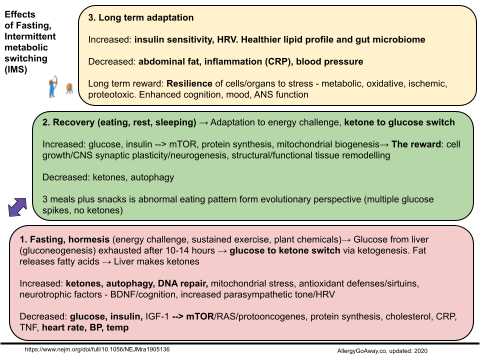


Effects of Fasting, Intermittent metabolic switching (IMS) (click to enlarge the image).

Fasting first causes the use of the glucose from the liver as a source of energy, produced via gluconeogenesis from glycogen from the stores in the liver. The glycogen is exhausted after 10-14 hours, then the glucose to ketone switch via ketogenesis is activated. The body fat releases fatty acids which the liver uses to makes ketones. This is illustrated in figure 2 here: https://www.pnas.org/content/111/47/16647, https://www.pnas.org/content/pnas/111/47/16647/F2.large.jpg

The metabolic processes and the roles of the different organs are shown in figure 2 here: https://www.nature.com/articles/s41514-017-0013-z/figures/2

Biochemical pathways involved in the metabolic switch are shown in figure 1 here: https://www.ncbi.nlm.nih.gov/pmc/articles/PMC5913738/figure/F1/

Signalling pathways by which neurons respond to the metabolic switch during fasting and exercise, shown in figure 2 here: https://www.ncbi.nlm.nih.gov/pmc/articles/PMC5913738/figure/F2/

Examples of effects of intermittent fasting on different organ systems are shown in figure 3 here: https://www.ncbi.nlm.nih.gov/pmc/articles/PMC5411330/figure/F3/

Mark P. Mattson has reviewed hormetic plant chemicals here, see the figures: https://www.ncbi.nlm.nih.gov/pmc/articles/PMC5841445/

Challenging oneself intermittently could improve health.

Fasting causes the following effects:

Increased: ketones, autophagy, DNA repair, mitochondrial stress, antioxidant defenses/sirtuins, neurotrophic factors - BDNF/cognition, increased parasympathetic tone/HRV

Decreased: glucose, insulin, IGF-1, mTOR/RAS/protooncogenes, protein synthesis, cholesterol, CRP, TNF, heart rate, BP, temperature

The recovery (eating) leads to ketone to glucose switch:

Increased: glucose, insulin, mTOR, protein synthesis, mitochondrial biogenesis. The reward: cell growth/CNS synaptic plasticity/neurogenesis, structural/functional tissue remodelling

Decreased: ketones, autophagy

3 meals plus snacks is abnormal eating pattern form evolutionary perspective (multiple glucose spikes, no ketones). See figure
1 here: https://www.ncbi.nlm.nih.gov/pmc/articles/PMC5411330/figure/F1

The intermittent metabolic switching (IMS) leads to long term adaptation:

Increased: insulin sensitivity, HRV. Healthier lipid profile and gut microbiome

Decreased: abdominal fat, inflammation (CRP), blood pressure

The long term reward includes a resilience of cells/organs to stress - metabolic, oxidative, ischemic, proteotoxic stress, enhanced cognition, mood, ANS function.

The adaptive responses of major organ systems to intermittent fasting are shown in figure 2 here: https://www.ncbi.nlm.nih.gov/pmc/articles/PMC3946160/figure/F2/

Neural circuits and cellular signaling pathways that mediate adaptive responses of the brain to fasting are shown in figure 4 here: https://www.ncbi.nlm.nih.gov/pmc/articles/PMC3946160/figure/F4/?report=objectonly

A model for how intermittent metabolic switching may optimize brain performance and increase resistance to injury and disease, shown in figure 3 here: https://www.ncbi.nlm.nih.gov/pmc/articles/PMC5913738/figure/F3/

Patterns of daily and weekly food consumption, shown in figure 3 here: https://www.ncbi.nlm.nih.gov/pmc/articles/PMC4250148/figure/fig03/

Mark Mattson recommended 5:2 diet with restricted time eating. 5:2 implies eating over a 6-hour time frame for 5 days, followed by 2 days of fasting. Fasting is defined as eating 50 calories per day, not water fasting. Mark Mattson advocates for this approach to be continued indefinitely, see figure 4 here: https://www.nejm.org/doi/full/10.1056/NEJMra1905136

Valter Longo proposed a fasting mimicking diet (FMD) which consists of low calories meals for 5 days, followed by a longevity diet, which is mostly plant-based diet. The fasting mimicking diet is eaten between every month to every 6 months based on the risk factors present in the patient. The fasting mimicking diet (Prolon) is available for purchased from Valter Longo's company and costs approximately $230 dollars for 5 days.

Most of the researchers involved in intermittent metabolic switching (IMS) via fasting are so convinced by the findings that they follow some fasting protocol or another. Discuss with your physician before trying fasting.

References:

Effects of Intermittent Fasting on Health, Aging, and Disease | NEJM https://www.nejm.org/doi/full/10.1056/NEJMra1905136#.Xg5Cpc_K93s.twitter

https://www.ncbi.nlm.nih.gov/pubmed/18162444

https://www.ncbi.nlm.nih.gov/pubmed/18162444

https://www.pnas.org/content/111/47/16647

https://www.ihmc.us/stemtalk/episode007/

https://www.nature.com/articles/s41514-017-0013-z#Fig2

https://www.ncbi.nlm.nih.gov/pmc/articles/PMC5841445/

https://www.ncbi.nlm.nih.gov/pmc/articles/PMC4267452/

https://www.ncbi.nlm.nih.gov/pmc/articles/PMC5411330/

https://www.ncbi.nlm.nih.gov/pmc/articles/PMC3946160/

https://www.ncbi.nlm.nih.gov/pmc/articles/PMC5913738/

https://www.ncbi.nlm.nih.gov/pmc/articles/PMC4346441/

https://www.ncbi.nlm.nih.gov/pmc/articles/PMC5783752/

via CasesBlog - Medical and Health Blog More READ

Thursday, 3 October 2019

How Balding Became Big Business, and the market is expected to grow even further - WSJ video

How Balding Became Big Business - WSJ video: Only 2 medications are FDA-approved as of 2019: minoxidil and finasteride:


References:

https://on.wsj.com/32SeoPz via CasesBlog - Medical and Health Blog More READ

Wednesday, 2 October 2019

How to Take Care of Your Eyes as You Age: be aware of GMC: Glaucoma, Macular degeneration, Cataract

From Consumer Reports:

Glaucoma

More than 2 million Americans have glaucoma, but 50% know it. Glaucoma often goes undiagnosed because it causes no symptoms until vision declines, at which point treatment no longer helps. People aged 40-60 should be examined by an optometrist every 3-5 years; those older than 60 need an eye exam every 1-2 years.

Many eye doctors screen for glaucoma with tonometry (measures eye pressure) but that’s not enough. Relying only on intraocular pressure (IOP) when screening for glaucoma could miss up to 50% of all cases. The exam should also include an ophthalmoscopy, which involves examining your optic nerve.

The most common treatment for glaucoma is eye drops known as prostaglandin analogs (PGAs), which lower eye pressure. Generic versions of most of those drugs are much cheaper than the brand-name versions.

Age-related Macular Degeneration (AMD)

There are two main forms of AMD:

1. Dry AMD, more common variety, which is treated mainly with dietary supplements

A specific blend of vitamins and minerals known as AREDS (vitamins C and E, plus copper, lutein, zeaxanthin, and zinc) lowers the risk of dry AMD progression by 25%. It’s the only treatment as of 2019.

Not all eye supplements contain the proper formulation. In an analysis of 11 eye-health supplements, only 4 contained the right mix: PreserVision Eye Vitamin AREDS Formula, PreserVision Eye Vitamin Lutein Formula, PreserVision AREDS2 Formula, and ICAPS AREDS.

Don’t bother taking any supplement with the hope that it will prevent AMD, no research supports that as of 2019.

2. Wet AMD, the more serious form, which requires monthly injections from an ophthalmologist with one of three drugs.

For wet AMD, consider an inexpensive drug vs the expensive ones. There are 3 drugs used to treat wet AMD—aflibercept (Eylea), bevacizumab (Avastin), and ranibizumab (Lucentis). Avastin costs just $50 per month, compared with $2,000 for the others. Avastin is officially approved only as a cancer drug and and you would need a compounding pharmacy.

References:

https://www.consumerreports.org/vision-eye-care/how-to-take-care-of-your-eyes-as-you-age/ via CasesBlog - Medical and Health Blog More READ

Tuesday, 1 October 2019

Keep Things Simple For A Healthy, and Hopefully Longer, Life

By my former colleague at the University of Chicago, John Schumann: Keep Things Simple For A Healthy, Long Life:

1. Get enough sleep.

2. Move your body throughout the day.

3. Eat well — a healthy assortment of foods. Mostly plants, and not too much.

4. Interact socially. Isolation is not good for the body, soul or mind.

5. Take some time to reflect on what you are grateful for.


Interventions that promote longevity, remembered by mnemonic: DEEP purple - “eat colorful plant foods: Dietary modification, Exercise, active Engagement, Purposeful living (click here to enlarge the image).

References:

https://www.npr.org/sections/health-shots/2016/01/02/459970110/keep-things-simple-for-a-healthy-long-life via CasesBlog - Medical and Health Blog More READ

Wednesday, 18 September 2019

Being hungry may lead to poor decisions, focused on on short-term rewards

There is evidence that hunger increases discounting for food rewards, biasing choices towards smaller but sooner food reward over larger but later reward.

Researchers found strong evidence that hunger causes large increases in delay discounting for food, with an approximately 25% spillover effect to non-food commodities. This discounting can cause negative outcomes in many non-food domains:

- consumer
- investment
- medical
- inter-personal

Caution may be necessary when making decisions involving non-food outcomes while hungry.

In conclusion, sleep and eat on it, before making a final decision.

References:

https://link.springer.com/article/10.3758/s13423-019-01655-0

https://www.irishexaminer.com/breakingnews/world/empty-stomachs-lead-to-poor-decisions-research-says-951019.html via CasesBlog - Medical and Health Blog More READ

Friday, 13 September 2019

Fasting mimicking diet (ProLon) by Valter Longo, PhD


Interventions that promote longevity, remembered by mnemonic: DEEP purple - “eat colorful plant foods: Dietary modification, Exercise, active Engagement, Purposeful living (click here to enlarge the image).

Valter D. Longo (born October 9, 1967) is an Italian-American biogerontologist and cell biologist known for his studies on the role of fasting and nutrient response genes on cellular protection aging and diseases and for proposing that longevity is regulated by similar genes and mechanisms in many eukaryotes. He is currently a professor at the USC Davis School of Gerontology with a joint appointment in the department of Biological Sciences as well as serving as the director of the USC Longevity Institute. Dr Longo (PhD) is widely publsihed, he has more than 120 articles listed in PubMed as of 2019: https://www.ncbi.nlm.nih.gov/pubmed/?term=Longo%20VD%5BAuthor%5D&cauthor=true&cauthor_uid=31442398

Valter Longo's longevity diet proposals relies on 2 major approaches:

1. Daily longevity diet, which is mostly plant-based with fish once to twice a week.

2. Episodic fasting mimicking diet, which is a 5-day low calorie diet. Fasting mimicking diet is used every 6 months to every 1 month based on the condition of the patient.

More details are available in the videos below and in Valter Longo's 2018 book, linked below.

Fasting mimicking diet (ProLon)

Valter Longo's fasting-mimicking diet (FMD) is a low-calorie, low-protein, low-carbohydrate, high-fat meal program that is claimed to mimic the effects of periodic fasting or water fasting over the course of five days, while still aiming to provide the body with nutrition. FMD is considered a periodic fast.[9]

Longo developed the diet at the University of Southern California. He believes that it is possible to mimic the effects of fasting with a meal program that is designed to inhibit the same metabolic pathways fasting would, thereby providing the body with nutrients that do not trigger the body’s growth responses (including stem cells).

Fasting mimicking diet is trademarked by L-Nutra, a company partially owned by Longo with financial interest by USC, though Longo does not receive any financial benefits from the company.

FMD application has been explored in patients with metabolic abnormalities, autoimmune disorders and cancers.

Here is a recent overview of the experience: https://www.technologyreview.com/s/614082/prolon-starvation-diet/

Mark Hyman, MD: The Secret Power of Fasting for Longevity and Healing, 2019:


References:

https://www.ncbi.nlm.nih.gov/pmc/articles/PMC6528490/
https://www.ahajournals.org/doi/full/10.1161/CIRCRESAHA.118.313352?url_ver=Z39.88-2003&rfr_id=ori:rid:crossref.org&rfr_dat=cr_pub%3dpubmed
https://www.amazon.com/Longevity-Diet-Discover-Activation-Regeneration/dp/0525534075
https://prolonpro.com/
https://www.youtube.com/watch?v=zz4ZzNik1Y4
https://www.technologyreview.com/s/614082/prolon-starvation-diet/
https://www.youtube.com/watch?v=dVArDzYynYc
https://www.bluezones.com/2016/04/fasting-for-longevity/
https://en.wikipedia.org/wiki/Valter_Longo
https://gero.usc.edu/faculty/longo/
https://www.youtube.com/watch?v=evGFWRXEzz8
https://www.kevinrose.com/post/valter-longo
https://www.statnews.com/2017/06/13/fasting-diet-valter-longo/
https://drhyman.com/blog/2019/04/10/podcast-ep48/
http://casesblog.blogspot.com/2018/12/exceptional-longevity-why-some-people.html via CasesBlog - Medical and Health Blog More READ

Saturday, 10 August 2019

Michal Kosinski: "The End of Privacy" | Talks at Google

Michal Kosinski is an Assistant Professor of Organizational Behavior at Stanford’s Graduate School of Business. He has published on privacy risks, psychometrics, and psychological profiling.

via CasesBlog - Medical and Health Blog More READ

Thursday, 8 August 2019

"Cardio IQ Advanced Cardiovascular Tests" by Quest

"Cardio IQ Advanced Cardiovascular Tests" are marketed by Quest labs and recently discussed by Dr Hyman and Dr Attea here: https://www.youtube.com/watch?v=n5bLggnbtyI

Quest has a 2016 webinar that discussed why Advanced Cardiovascular testing is beneficial, reviewed two cardiovascular risk factors Lp(A) and ApoB, biomarkers for assessment of inflammation, clinical importance of LDL sub-fractions, introduced the Cardio IQ Report as a management solution beyond the routine lipid panel: https://education.questdiagnostics.com/presentations/advanced-insights-into-residual-cardiovascular-risk?presentation_id=262

More info about the test and examples are here: https://www.questdiagnostics.com/home/physicians/testing-services/condition/cardiovascular/cardio-iq-report.html

Here are additional tests focused on cardiovascular and metabolic diseases:
https://www.questdiagnostics.com/home/physicians/testing-services/condition/cardiovascular/cvd-test-descriptions.html

References:
https://www.questdiagnostics.com/home/physicians/testing-services/condition/cardiovascular/cardio-iq-report.html
https://www.questdiagnostics.com/home/physicians/testing-services/condition/cardiovascular/cvd-test-descriptions.html
https://www.questdiagnostics.com/dms/Documents/cardio/PT04-AdvancedCardiovascularTests.pdf
https://education.questdiagnostics.com/presentations/advanced-insights-into-residual-cardiovascular-risk?presentation_id=262 via CasesBlog - Medical and Health Blog More READ

Wednesday, 29 May 2019

Making the impossible look effortless... for hundreds of years

Ian Gillan, singer/songwriter of the hard rock legendary band Deep Purple, on the musicianship of his colleagues at 1:30 min in the video below: "performing live, they are making the impossible look effortless."

That's a good goal for any profession. And you just hope you can continue doing for "hundreds of years."


Source:

https://www.thehighwaystar.com/news/2019/05/28/well-be-back-in-300-years/ via CasesBlog - Medical and Health Blog More READ

Friday, 24 May 2019

Cleveland Clinic in London

The new Cleveland Clinic building in London is growing from within - see for yourself - it's just across from the Buckingham Palace:


Cleveland Clinic London is on track to open a new 200-bed private healthcare facility near Buckingham Palace in January 2021. The opening will coincide with the system's centennial.

https://clevelandcliniclondon.uk


Cleveland Clinic London will focus on 4 specialties: cardiology, orthopedics, digestive disease and neurology. And it will open 3 outpatient facilities. The Clinic will employ about 50 doctors and a staff of about 200.

https://www.cleveland.com/healthfit/2018/08/cleveland_clinic_london_openin_1.html

Disclaimer: I work as an Allergist/Immunologist at Cleveland Clinic Florida. via CasesBlog - Medical and Health Blog More READ